
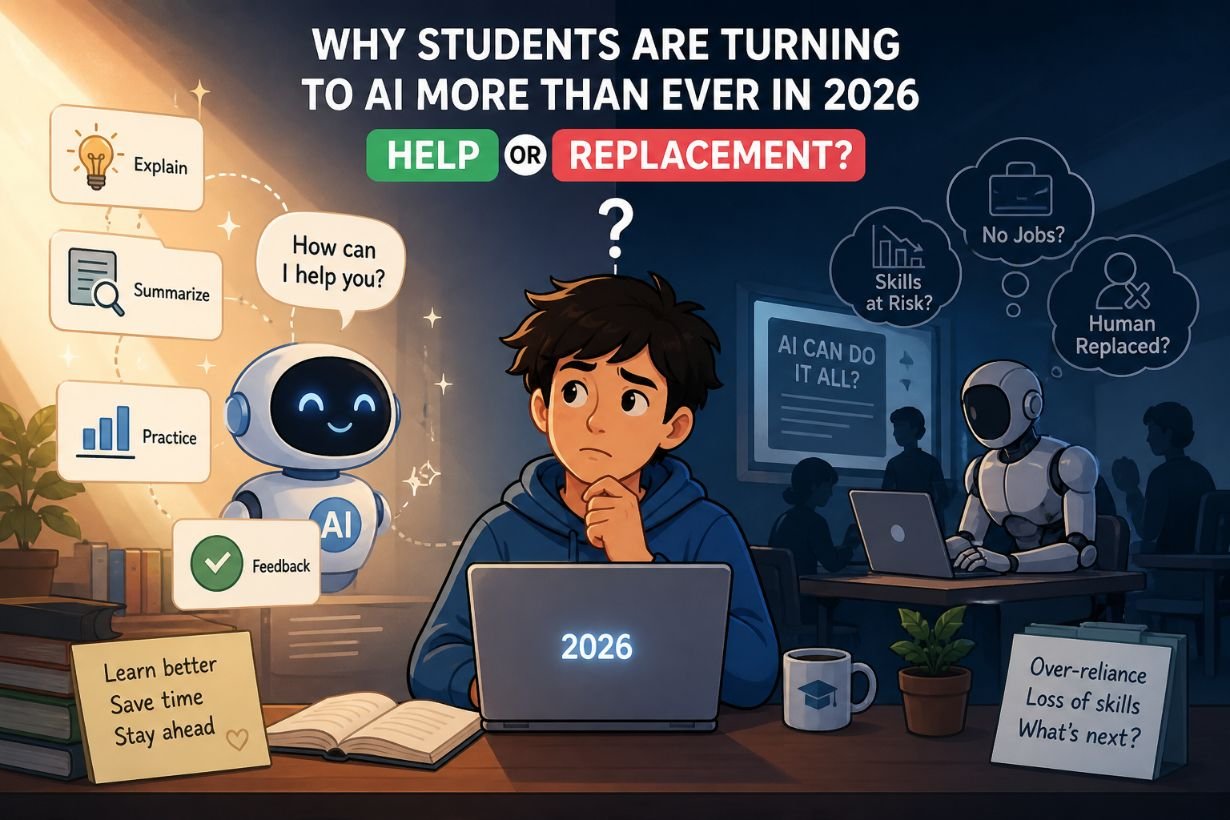
Not so long ago , students used textbooks and their own brain for solving Maths equations. But today all they need to do is use AI to click a photograph and send it so that equation is solved for them without any effort . Is that how AI was really supposed to help ? Let us be very honest , This is not the real use of artificial intelligence .
Across the world the use of AI is rising every single second , It has become a part of our daily life. This clearly shows how technology is changing the way students approach learning and problem-solving in their daily academic lives.One of the major reasons behind this huge shift is that AI provides instant results. Instead of searching over 100+ websites and waiting for guidance, just one voice search could tell your child whether you use ‘have’ with the main verb or the helping verb . AI not only solves problems but also explains concepts in a way easy to learn , making learning more efficient and faster. This not only saves time but also reduces the effort students need to put into basic understanding, making studies feel less tiring. In many cases, students prefer such quick solutions because they are easy and accessible at any time.
But again let’s be real students today have a lot to deal with from assignments to exams everything comes with a tight deadline and constant expectations, managing time can be challenging . That’s where AI becomes helpful , it saves lots of time and makes our work even easier especially when everything feels too overwhelming. AI tools can speed up research and provide quick guidance , helping students work at time and reduce stress. For example, during exam periods, students often struggle to balance revision and assignments, and AI becomes a quick support system in such situations. This shows how AI is not just a tool but has become a part of students’ daily academic routine.
Despite all its benefits, AI gives us a lot of drawbacks as well . The use of AI also raises concerns . Educators worry that over dependency on AI can reduce critical thinking and problem solving skills . Experts have come out to many cases where students depend on direct answers without understanding the concept fully. This would later result in his/her performance in the classroom where the real knowledge quiz begins.
As a result, many schools and teachers are now discussing how to limit the overuse of AI and encourage students to think independently. This raises an important question about how much use of AI is actually too much.Not every student learns in a similar way. Everyone has their own pace to understand different things and AI is designed in a way that it can adjust itself according to the student’s comfort . It explains difficult topics in a simpler way. This allows students to receive targeted support to improve their overall academic performance . For instance, a student who struggles with a particular subject can use AI to get step-by-step explanations until the concept becomes clear.
This kind of personalized support makes learning more comfortable and less stressful.Looking Ahead , If things are already changing rapidly , imagine what the future is supposed to look like . Schools and Institutions are already exploring ways to include AI in a more structured way so that AI not only helps with smart learning but also personalized study plans. In the coming years, AI might become a regular part of classrooms, helping both students and teachers in new and innovative ways.
However, it will be important to ensure that it supports learning rather than replacing real effort.To sum it up , AI is rapidly becoming a crucial part of our lives. It has made our lives easier and faster by just existing, however it also comes with its own risks. A balanced approach is essential to ensure that students benefit from technological advancements without compromising critical thinking skills . While it offers speed , convenience and support , real learning still requires real effort and understanding. At the end of the day, AI should be used as a helping tool and not as a shortcut to avoid learning.
Want to learn more information